Monday, 27 February 2017

Module 3 Update

After deferring Module 3 due to a very busy schedule; I am beginning my studies and feeling very overwhelmed at the work load ahead as always!. This time however I am excited to get stuck in and give my all to module 3. I decided it would be beneficial to refresh my mind after a long period of time and read my module 2 proposal and feedback along with module 3 and reader 7. I made notes and re-read aspects to gain clarity on what stage I was currently at with my inquiry and the steps I needed to take in order to complete all elements of my inquiry before the submission date. Time management will be crucial in the process. As stated in Module 3 handbook, 'many of the elements of the professional inquiry require activities to be carried out parallel'.  Devising a detailed action plan helped me to envision all aspects of my inquiry process and organise the steps I need to take to ensure I achieve my goals in the time frame given.

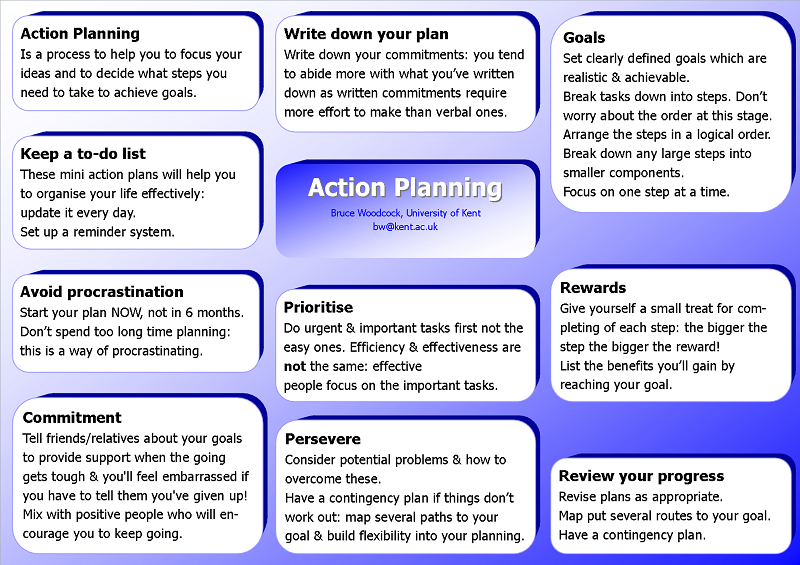
The following image from Kent Universities website motivated me to begin creating an achievable plan. 
                                         https://www.kent.ac.uk/careers/sk/skillsactionplanning.htm#steps

I used the sample framework provided in this link https://www.kent.ac.uk/careers/sk/skillsactionplanning.htm#steps
.. I particularly found rewarding myself and reviewing progress beneficial. Rewards are providing motivation for me to complete tasks stated on my plan and reviewing my progress regular helps me to analyse what obstacles I am facing in terms of  my plan and how i can overcome these. An example of this would be how I occasionally feel very enthusiastic and energetic about the day ahead and plan to many activities or underestimate the time scale of a particular task. Breaking my plan down into small tasks makes goals appear achievable and therefore helps me reduce procrastination.

Creating a plan allowed me to envision the stage I was currently it with my inquiry and made writing my BAPP update for Paula a much simpler task.

BAPP UPDATE:
                                          
Module 3 Update

 Interviews
Having re-read my professional inquiry proposal submitted for Module 2 and the feedback provided; I intend to pursue the following research questions.

  • Do actors approach developing character differently depending on whether the role is part of a Musical or Dramatic play on stage or screen?
  • Can a background in Musical Theatre inform working as an actor/actress in dramas on stage and screen?

I originally planned on researching the following also:

·         What are the similarities and differences in terms of rehearsal process, stage craft and performance between Musical theatre and dramatic acting on stage and screen?
 Following a discussion with a peer, I concluded that this question was ambiguous and could potentially be explored within the previous two research questions presented, however I will continue to discuss this question within my SIG.

·         What are people’s perceptions of Musical Theatre?
The feedback I received for this question was as follows ‘Yes they are, If so how?
I struggled to make sense of the feedback and would benefit greatly from a further discussion regarding this in a tutorial. I will also explore the question further with my peers. It is a question I am extremely intrigued to investigate, however, peoples opinions cannot be changed therefore has left me debating the relevance of this question to my inquiry.

Ethics
I am aware that the ethics board has approved the research I will be conducting for my practitioner inquiry. I am aware of the consent forms I need to provide to participants.
I also prepared an email thanking all interviewees for their participation. I sent a draft of my email to Paula and established important information I had not included in regards to ethical issues.
  I then re-drafted my email including information about data protection, explanation of methods used to record data, anonymity and time scales/interview lengths.
Following the feedback I re-read the ethics section of my professional inquiry plan and also revised reader 5/6 to ensure all potential ethical issues had been covered.

Carrying out my research
Two of my interviews will be carried out week commencing 27th Feb 2017; therefore it was essential for me to prioritize this particular aspect of my inquiry whilst working parallel to source literature for me review. As mentioned, I have carefully considered ethics in relation to my interviews whilst also ensuring I am fully prepared and have a range of relevant questions to present to participants. I have critically analysed these questions to guarantee they are unbiased and non leading. I would appreciate feedback on my questions from a peer or tutor if possible.
Currently I have 7 valuable sources of literature, including those mentioned in Module 2 of which I have already began critically reading and analysing. Creating a colour coded note system has assisted me in categorizing crucial information.
‘Community of practice’ and ‘Networking’ are reoccurring themes in my investigation through discussions. I will be studying Wenger’s theory in relation to this in aid of my inquiry. I will continue sourcing literature using the following questions from ‘reader 7’ to determine the significance of the text.

·         Who is the author/authors/Publisher of the text?
·         When was the text written?
·         Where was the text written/produced?
·         Who is the intended audience for the text?
·         What are the authors/publishers intentions in relation to the reader?
·         What is the writer’s own position in relation to the subject being written about?
·         What assumptions are the authors/publishers making and how does this invite the reader to share them.
·         What is the style of the writing of the text, and how does this affect the reading of this text?

Artefact
In terms of the artefact my initial thoughts are to create an informative guide on ‘The transition from Musical theatre to specialising in dramatic acting on stage and screen. I will include skills which could be transferable and advise on transitioning both on and off stage.

SIG
I plan on focusing my attention this week on interacting with others on Module 3. As I deferred, I am unfamiliar with research topics other module 3 students have chosen. I will be joining SIG’s posting blogs and joining social networking groups in order to establish connections and discover how my self and my peers can assist in developing each others research. 


Critical Reflection On Professional Practitioner Inquiry

Critical Reflection on professional Practitioner Inquiry

Introduction
Module 2 has given me the opportunity for professional growth by enabling me to further investigate my practice through the process of inquiry. Tasks 4, 5 and 6 where challenging yet extremely helpful in preparing me for the planning of this process.


Lines of Inquiry
Developing inquiry questions was the toughest obstacle I faced throughout the module; this was due to the variation in my career at present and the uncertainty of where it was heading. Too overcome this issue, I took advantage of underpinning knowledge gained in module one and discussed potential ideas and questions via my Google community, blog comments, SIG and Skype sessions. (Appendix 1). Establishing my skills and competences also aided me in choosing my inquiry topic. (appendix 2 ) Upon deciding on a topic I focused on literature which expanded my knowledge on my current practice and areas of study (appendix 3)

Ethics
Reader 5 brought too my attention how little I actively consider ethics within my practice. Upon reading professional documents
Such as job contracts, I realised I held this information tacitly (appendix). Researching ethics encouraged me too consider how our professional ethics occasionally conflict with personal ethics.
‘Ethics isn’t always a case of black and white; there are grey areas’ (Reader 5, page 7 Middlesex University) (appendix 4)  I used my new found knowledge from the reader to complete my ethics release form.
 I found it difficult too discuss ethics in relation too my inquiry topic as the majority of other students undergoing the module are focusing on teaching and had lots in common in terms of both their professional practice and inquiry.

Methods
Bell (2002) states ‘Understanding the major advantages and disadvantages of each approach is likely to help you to select the most appropriate method’
I used this quote too assist me in deciding on methods of which I deemed most appropriate for my inquiry. (appendix 5)  as certain interview would be the best method as the data I am relying upon is ‘qualitative’ I conducted a pilot interview too confirm this whilst taking into considerations ethical requirements, style of interview and interview context (appendix). I struggled too decide on a second data collection tool. I discussed this issue with a colleague and decided the use of my journal would be crucial. Observations would also provide me with qualitative data however I will review this tool further and make an informed decision of whether this would be possible in terms of scheduling and ethical considerations (appendix).The pilot experience provided me with the skills and knowledge to execute my personal inquiry with confidence in Module 3.

Conclusion
Module 2 has been difficult yet has provided me with a wealth of knowledge and curiosity in relation to me professional practice. Applying time management skills studied in module 1 enabled me too keep on track with my inquiry plan.  I do believe I would have benefitted further through more communication within my SIG in the initial stages; however due to my professional schedule, found this difficult I completed tasks in my journal rather than on my blog and relied on cast members and other colleagues too support the development of my inquiry.  I am positive I have a strong basis for my inquiry and look forward to progressing further. 

Saturday, 7 May 2016

Changes to inquiry tools

 A conversation with Paula led me too reconsider my original proposed data collection tool 'Questionnaires/surveys'. We discussed the reasons behind my decisions and upon reflection concluded that they lacked clarity and were unnecessary to my inquiry.

Original Proposal

'Questionnaires/Surveys
 I plan too create a questionnaire compiled of precise questions relating too my inquiry topic.  It is crucial FOR ME TOO CONSIDER Reflexivity and remain objective when structuring questions in order for my data to be valid during the analytical stage.  "A researcher's background and position will affect what they choose to investigate, the angle of investigation, the methods judged most adequate for this purpose, the findings considered most appropriate, and the framing and communication of conclusions" (Malterud, 2001, p. 483-484).
I will select a variety of both closed questions and questions allowing the participant too choose from a choice of declarations or a blank space allowing participants too openly answer the question written. Despite being aware that my findings will lack depth, I will make use of data in terms of breadth. This will enable me too study peoples perception of Musical Theatre and their methods of creating character in terms of their professional medium on a much larger scale. I will conduct a pilot questionnaire to establish questions that are gaining irrelevant responses or could be perceived as misleading.  I plan too utilize my knowledge of professional networking and web 2:0 when handing out my questionnaire. Professionals are local; I will hand out my questionnaires face to face; if this is not feasible

I will keep my questionnaire web based using sites such as survey monkey as the vast majority of professionals have access too the internet.
Providing A sampling frame, similar too the diagram below, will be put into place too ensure I have sufficient numbers of representatives ‘in categories or variables of specific interest’ Reader 5, page 24

I will take a qualitative and quantitative approach too analyzing data from surveys, firstly it is essential for me too create an easy too follow numerical coding system. Secondly I will use ‘Survey Monkey’ to analyse my coded data or create a spreadsheet if my surveys where handed out on paper. I will then review questions with open responses in a qualitative manner too reflect on occurring trends and the reasoning behind them. For example:

‘Do you believe there is a stigma surrounding Musical Theatre’?
1. Yes
2. No
3. Unsure
Please give reasoning for your answer……..

The above question will not only provide me with insight too peoples perceptions but also provide me with background knowledge of how the perception came about' Laura Gregory, 2016


Keeping a journal of my practice and experiences throughout the transition from Musical Theatre performer too acting for Drama will be vital to my inquiry, in order for me too make this personal journey. I will record all professional experiences and conversations and later evaluate my findings  in order too establish any development. 

Observation is a tool of which I initially ruled out of my inquiry, however since reviewing reader 6 for a second time, I realised it could be extremely useful. Below are the merits and limitations of using observations as a data collection method in relation to my inquiry.

Merits: 
  • Qualitative visual data
  • Experience first hand how rehearsals or performances differ in different mediums
  • Different methods to record observations
  • Examine physical behavior
Limitations:
  • Time consuming
  • Lots of ethical considerations


Friday, 22 April 2016

6B Tools and Methods

To gain a clear insight of the tools/methods I could potentially use to conduct my Inquiry, I reviewed both Merits and Limits for each one. I decided that 'observations' would be an unsuitable method of data collection due to the nature of my inquiry. 

Interviews

Merits:

  • As the interviewer, I will have full control of the topics discussed and the style of interview. If I feel the interviewee is discussing something interesting I can delve deeper and ask why?
  • I will have the power to select interviewees with expertise in my area of study.
  • Answers will be detailed.
  • Can record the interview using a dictaphone to later analyse as well as jotting notes, this way I will be able to pick aspects up which I missed in the first instance.
  • Capture verbal and non verbal communication.
Limits:
  • Can be time consuming
  • Interviewee may be unable too attend
  • Interviewee may be nervous and therefore be reluctant to answer honestly or be open.
  • Interviewee may disprove of the interview being recorded.

Surveys

Merits:
  •  People may be more honest if they are anonymous and don't have the pressure of an interview environment.
  • Can gain information from a wider range of people. 
  • Easy to share via web 2:0, Survey Monkey Etc.
  • Quick and easy method too collect data
Limits: 
  • Would have to really on the appropriate people to take part in my survey.
  • Questions would be specific therefore I may not get all the information I require.
  • It will be difficult too ask questions that are not too general or detailed.

Documents

  • Merits:  
  • Literature could supply me with more knowledge and back up my findings.
  • Could potentially use sites such as spotlight too see if there is a correlation between where people have trained and working in different mediums.
Limits:
  • There is a limit to the amount of documents I could view. 
  • I would have too know more about the professional CV's I was viewing as people have different career choices. 

Tuesday, 19 April 2016

6C Proposed Award Specialism Title

I would like to propose my award title to be BA Hons in Professional Practice Acting.

In order for my inquiry too be meaningful. I have decided too focus on an area of the Arts I have a strong interest in 'Acting'. I have a great yearning for success as an actress and as a insider researcher, intend to explore, investigate and expand my knowledge too improve my professional practice. Since graduating from the Professional Musical Theatre course at the Hammond in Chester, I have worked professionally in Musical Theatre and Pantomimes. Roles I have played too this date have been heavily acting based which have spurred me too strive further in the world of acting and move onto straight plays and screen acting.
I have chosen to focus my inquiry around the transition from acting in Musicals too acting in straight plays. My aim is too investigate and compare how performers approach creating character and prepare for roles in both mediums. I will also research how Musical Theatre artists are perceived in terms of straight acting and whether this has any effect on making the transition as well as looking into the amount of Performers working in both mediums and there backgrounds. I will use my inquiry too not only too aid my progression but also too inform  Musical Theatre artists who wish too focus there attention on one aspect of the arts whether it be dancing, singing or acting.

Friday, 15 April 2016

Literature Review 1

Title: Uta Hagen Respect for Acting
Published: September 1973 by Wiley Publishing
Final Edition: 2015

As my inquiry will be based around transitioning from a Musical Theatre background to a career in straight acting both on stage and for camera; I decided too read Uta Hagen’s book about her experiences as a professional actress both on stage and screen and her life as an influential Drama teacher.

Uta was a German-American actress renowned for her work on Broadway and her short lived career in Hollywood. She was black listed from the film industry due too her association with Paul Robeson. She later taught at the Prestigious Herbert studios in New York

I read the whole of Uta's book and was utterly fascinated by her passion and dedication for the Arts and also her intricate ways of developing 'real life' Characters. From reading other BAPP blogs I have established that our Literature reviews at this stage are too be kept brief and are there too provide us with subject and research knowledge or our potential inquiry topics. For this reason I decided too focus on aspects of the book in which I could relate too my developing questions and current professional practice.

The book focuses particularly on acting in straight plays, however, occasionally makes reference too film. What I found interesting is that Uta refers too acting and character development as a whole. She does not discuss these in terms of mediums which suggest to me she uses the same technique regardless of the medium, having said that, this is just an assumption. Uta only makes brief comments about her film career; if she were too discuss this in more detail, my findings may differ.

In Part 1, The Actor, Page 17-18, Uta Discusses two types of acting.

Representational (external): 'deliberately chooses to imitate or illustrate the character’s behaviour' 

Presentational (Internal): 'attempts to reveal human behaviour through a use of himself, through an understanding of himself and consequently an understanding of the character he is portraying'

She explains how she uses Presentational Acting in her own work and also teaches using this method.

'I teach acting as I approach it, from the human and technical problems which I have experienced through living and practice' Uta Hagen, Respect for Acting, Page 18

Uta recognises that every actor is individual and can be successful regardless of the technique they choose too adopt.

'I do not reject in toto the representational, to do so would be to reject actors of brilliance who have found success along the path' Uta Hagen, Respect for Acting, Page 18

This quote relates too an early potential line of inquiry question I proposed. 'Which is better, Technique or Method acting?' the quote has enabled me too re evaluate my question and realise that my question is unethical as I made the assumption that one is better than the other. I plan too look through my other inquiry questions and check for bias and assumptions.


Uta later discusses the importance of training the outer instrument (voice and body). This is a pivotal part of Musical Theatre training in most establishments. We train our bodies through dance and our voice through both singing and speech. This certainly is an aspect of my training which lends its self too acting in all mediums, I also studied 'Alexander technique' which I am aware is very popular both on acting and Musical theatre courses across the UK. Alexander technique is a method used all over the world to improve posture and voice. 

In Part 3 of her book 'The play and the role', Uta discusses the process of bringing a character too life. An interesting point Uta Makes is that during the first read through of a script, we are audience members rather than actors. We laugh, we cry, we imagine the characters, relationships and circumstances as audience members. She emphasises the importance of reading the play as a whole too make considerations before delving into interpreting character. Regardless of the medium audience members are a vital part of our performance and it is important too see from their point of view. 


Throughout the book Uta makes reference too a set of questions she uses too create a character:
Who am I?
What Time is it?
Where am I?
What surrounds me?
What are the given circumstances?
What is my relationship?
What do I want?
What is in my way?
What do I need to do too get what I want?


Uta answers these in depth. I am aware of these questions and was encouraged too use them throughout my musical theatre training to develop character. I have never looked at these questions in as much detail as Uta. Uta considers every intricate detail. She believes that the more background knowledge we have about our character the more human behaviours will arise out of instinct and in turn create a realistic character. 

The rehearsal

Uta discusses ethical principles which she deems important when beginning rehearsals. In my opinion these are relevant too all mediums and therefore trans-disciplinary. 

'Be good colleagues! Be professional in the best sense of the word. Never tell each other what to do or what not to do. Make yourself responsible for serving the play and your colleagues, but don’t make them responsible for being at your service. Remember that egomania has been one of the chief causes of something being rotten in the state of the theatre. Don’t let yourself be a part of that'

As well as some of the above rules being natural instinct, I learnt about remaining professional, not directing other cast members and remaining grounded, through working in Musical Theatre.

Uta discusses the rehearsal process step by step through out this chapter. Uta’s experience of rehearsing for a straight play seems too differ quite a bit from any Musical Theatre. The process seems much slower and focuses intensely on building relationships and creating contexts and character building. For example, Uta discusses the stage around her. She asks her self more questions. This time regarding her relationships and the circumstances. She delves deep into aspects that some actors may over look. If there is a window on stage Uta sees beyond the window. She takes into consideration what she can see out the window, the curtains, what's on the window ledge? In my experience, Musical Theatre rehearsals focus on character building and building relationships but nowhere near as in depth. Rehearsals are not as long and emphasis is paced on choreography and learning music.

Another aspect of Uta’s work that differs from Musical Theatre is how she believes actors should have free reign too jump in and cut your line or maybe move too a different place across the stage. I do have my doubts about this statement. As even in straight plays the director has final say and if actors go against blocking set in rehearsals it may affect lighting cues etc. In terms of Musical theatre, if blocking was changed actors in the scene may disrupt choreography, or if a line is cut it could be detrimental too music ques. 


Tuesday, 12 April 2016

Ethical Considerations in relation to my Inquiry

I decided to do some extra reading in relation too my Inquiry and came across BERA (British Educational Research Association). They provide an ethical Guidance frame work to help with educational research Inquiries. I will use this information too ensure my inquiry is ethically sound.

The association considers that educational researchers should ensure all individuals are treated fairly. As the inquirer I will also be required too be sensitive and respect participants ethical beliefs in regard too culture, race, religion, politics ETC. I will also require consent from all involved (for this I will use the Ethics release forms provided by Paula). The guidelines state that 'Researchers must take the steps necessary to ensure that all participants in the research understand the process in which they are to be engaged, including why their participation is necessary, how it will be used and how and to whom it will be reported. Social networking and other on-line activities, including their video-based environments, present challenges for consideration of consent issues and the participants must be clearly informed that their participation and interactions are being monitored and analysed for research.' BERA Ethical Guidelines, Page 5. 
I plan on doing this using a written method and also explaining in person during interviews. I will also explain to the participants that they have the right too withdraw at any time and advise them that they are entitled too a copy of any documents containing personal data relating too them. Having said that, this may not apply too certain participants as they have the right too remain anonymous. If participants do not wish to remain anonymous, I will follow the Data Protection Act and ensure I have permission too use the personal information beforehand and keep the data secure.

In terms of methods, the guidelines explain how important it is too make sure findings are reliable, valid and generalisable. I will present them in a professional and straightforward way suitable for my targeted audience. I am already thinking of ethical issues arising from the methods I will be using and will discuss these in my SIG.

Below is a link to my SIG, I would be very grateful if you all could join and discuss ethical issues which may arise due too my chosen research methods and Inquiry topic.


Bibliography: